

Industrial equipment forms the backbone of modern manufacturing, logistics, construction, and energy production. From the assembly lines that produce consumer goods to the heavy machinery that shapes our infrastructure, these machines enable businesses to achieve scale, precision, and efficiency that would be impossible through manual labor alone. Understanding the common categories of industrial equipment—and the specific applications each serves—is essential for operations managers, procurement specialists, and engineers tasked with building and maintaining productive facilities.
This article examines the primary classes of industrial equipment, their defining characteristics, and the sectors in which they deliver the greatest value.
Heavy Construction and Earthmoving Equipment
Heavy equipment is engineered for large-scale physical work: moving earth, lifting massive loads, and preparing sites for development. These machines are characterized by high horsepower, reinforced chassis, and hydraulic systems capable of extraordinary force.
- Excavators — Used for digging foundations, trenching, and demolition. Their articulated booms and interchangeable attachments (buckets, breakers, grapples) make them indispensable on construction sites.
- Bulldozers — Employed for grading, pushing soil, and clearing land. Their tracked undercarriage provides traction on unstable terrain.
- Cranes — Tower cranes dominate high-rise construction, while mobile cranes serve infrastructure projects and heavy equipment installation.
- Loaders and Backhoes — Versatile machines for material handling, excavation, and site cleanup.
These machines are central to civil engineering, mining, road construction, and large-scale landscaping, where productivity is measured in cubic meters of material moved per hour.
Manufacturing and Production Machinery
Manufacturing equipment converts raw materials into finished goods through cutting, forming, joining, and assembly processes. This category spans from individual machine tools to fully automated production lines.
Machine Tools
Lathes, milling machines, drill presses, and CNC (computer numerical control) machining centers form the core of precision manufacturing. CNC equipment, in particular, enables repeatable tolerances measured in microns—critical for aerospace, automotive, and medical device production.
Forming and Fabrication Equipment
Press brakes, stamping presses, injection molding machines, and extruders shape materials into components at high volume. Injection molding, for example, produces millions of plastic parts per year for consumer electronics and packaging.
Assembly and Automation Systems
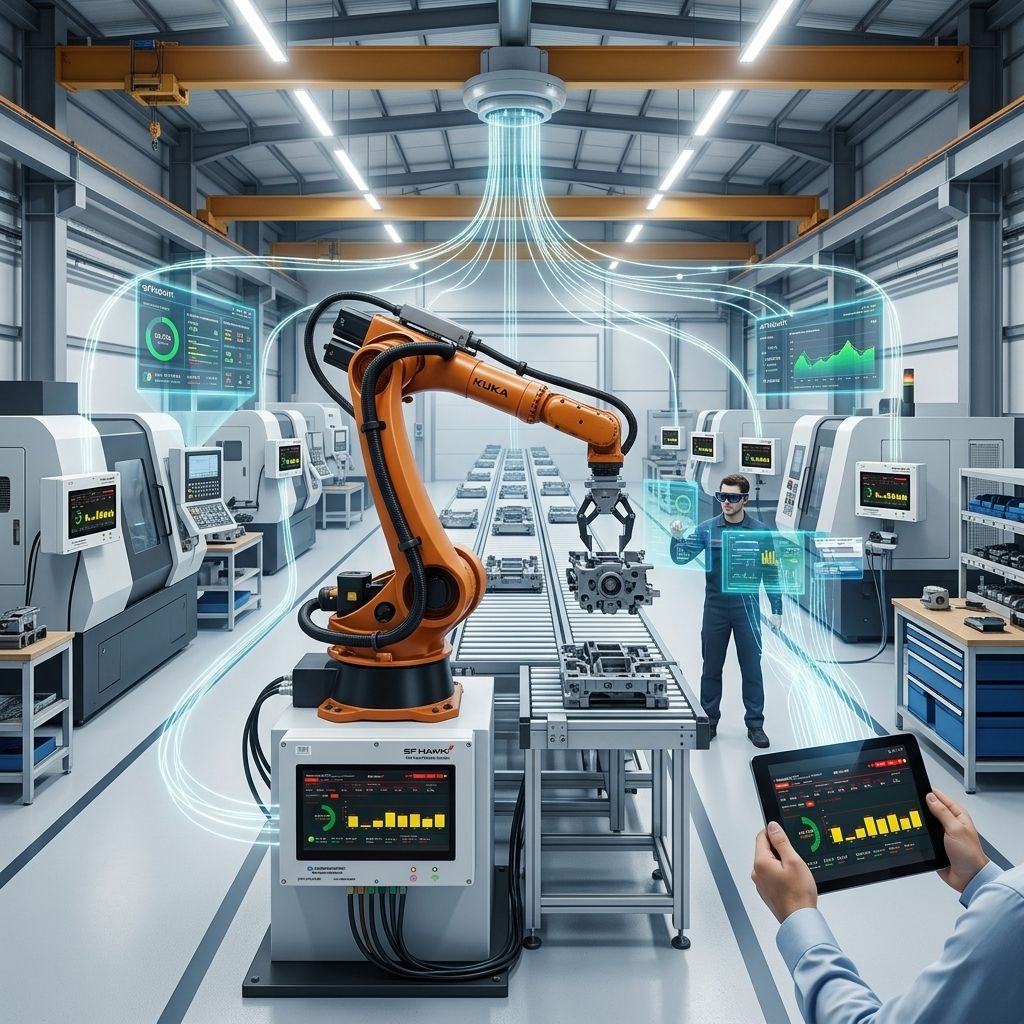
Conveyor systems, robotic arms, pick-and-place machines, and automated guided vehicles (AGVs) streamline assembly and material flow. Modern smart factories integrate these systems with sensors and software to achieve continuous, data-driven production.
Material Handling Equipment
Material handling equipment moves, stores, and controls goods throughout a facility. Efficient material handling directly reduces labor costs and injury risk while accelerating throughput.
| Forklifts | Lifting and transporting palletized loads | Warehouses, dock operations, manufacturing floors |
| Conveyors | Continuous movement of materials | Assembly lines, distribution centers, mining |
| Pallet Jacks | Low-level horizontal transport | Retail stockrooms, small warehouses |
| Automated Storage and Retrieval Systems (AS/RS) | Automated put-away and retrieval | High-density distribution, e-commerce fulfillment |
In logistics and e-commerce, material handling equipment is the difference between a fulfillment center that ships thousands of orders daily and one that bottlenecks at the loading dock.
HVAC and Environmental Control Systems
Industrial HVAC equipment regulates temperature, humidity, and air quality in facilities where environmental conditions affect both worker safety and product quality. Cleanrooms in semiconductor fabrication, for instance, require precise particulate control, while food processing plants demand strict temperature management.
- Chillers and cooling towers — Remove process heat from manufacturing operations.
- Industrial air handlers — Distribute conditioned air across large floor plates.
- Dust collection and filtration systems — Capture airborne contaminants in woodworking, metalworking, and chemical processing.
Properly specified environmental control equipment protects equipment investments, ensures regulatory compliance, and safeguards product integrity.
Power Generation and Energy Equipment
Industrial facilities often generate or manage their own power. Generators, turbines, boilers, compressors, and transformers keep operations running during grid interruptions and supply process energy.
Energy equipment selection hinges on load profiles, redundancy requirements, and fuel availability—considerations that directly influence operational resilience.
Process and Chemical Equipment
Industries such as pharmaceuticals, food and beverage, and petrochemicals rely on specialized process equipment: reactors, heat exchangers, mixers, centrifuges, and distillation columns. These systems are typically constructed from corrosion-resistant alloys and designed to meet stringent sanitary or safety standards.
In pharmaceutical manufacturing, for example, bioreactors and filtration systems must comply with validation requirements that govern every wetted surface and cleaning procedure.
Selecting the Right Equipment for Your Operation
Equipment selection should be driven by application requirements rather than brand familiarity. Key evaluation criteria include:
- Throughput and capacity — Does the machine meet current and projected volume demands?
- Total cost of ownership — Purchase price, maintenance, energy consumption, and downtime costs.
- Compliance and safety — Adherence to OSHA, ISO, and industry-specific standards.
- Integration potential — Compatibility with existing systems and future automation plans.
- Service and support — Availability of parts, technicians, and training.
A disciplined procurement process—supported by lifecycle cost analysis and vendor due diligence—prevents costly mismatches between equipment capability and operational need.
Conclusion
Industrial equipment spans an enormous range of machines, from earthmoving giants to micron-precision machining centers. Each category exists to solve a specific operational problem, and the most successful facilities are those that match equipment capabilities to production goals with precision. Whether you are outfitting a new warehouse, upgrading a production line, or expanding energy capacity, a clear understanding of equipment types and their applications is the foundation of sound capital investment.