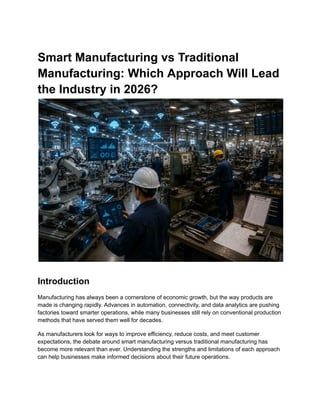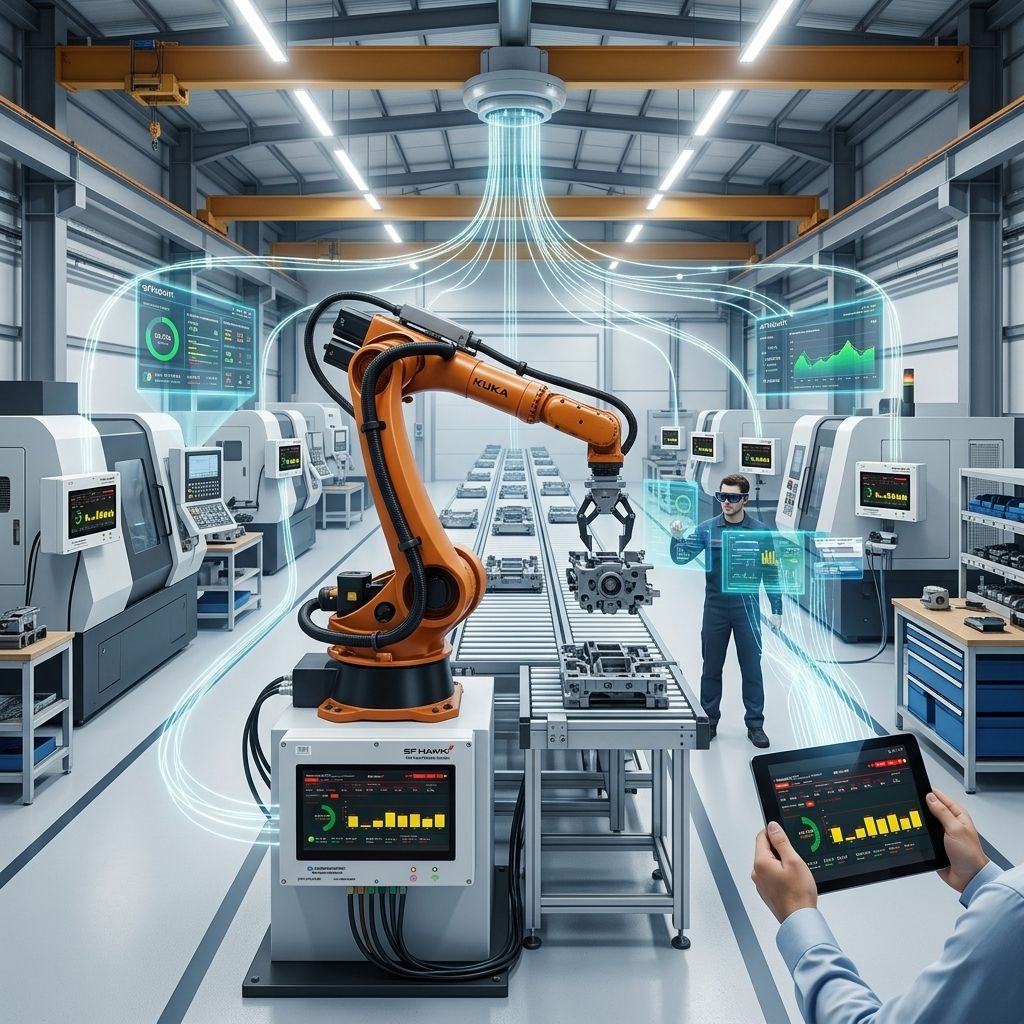


Modern manufacturing is no longer simply about assembling parts on a line. It is a tightly orchestrated convergence of automation, data science, materials engineering, and digital connectivity. The factories producing today’s electronics, vehicles, medical devices, and industrial equipment operate as integrated cyber-physical systems, where machines communicate with one another, software simulates outcomes before a single cut is made, and supply chains respond to demand in near real time. Understanding how these processes work is essential for anyone navigating the technology landscape, whether as an engineer, a product leader, or an investor.
This article breaks down the core mechanisms of modern manufacturing, from design and simulation through production, quality control, and continuous improvement.
The Digital Thread: From Design to Production
The journey of a modern manufactured product begins in software, not on the shop floor. The digital thread is the connected flow of data that links design, engineering, production, and service across the product lifecycle. It typically starts with Computer-Aided Design (CAD), where engineers create precise 3D models of components and assemblies. These models feed directly into Computer-Aided Manufacturing (CAM) systems, which generate the machine instructions used by production equipment.
Critically, modern workflows insert simulation between design and production. Finite Element Analysis (FEA) and Computational Fluid Dynamics (CFD) allow engineers to test structural integrity, thermal behavior, and airflow virtually, long before physical prototypes exist. This simulation-first approach reduces costly redesigns and shortens time-to-market considerably.
Key stages in the digital thread
Automation and Robotics on the Factory Floor
Automation is the backbone of modern production. Industrial robots perform welding, painting, pick-and-place assembly, and palletizing with repeatability that far exceeds human capability. Collaborative robots, or cobots, are designed to work safely alongside human operators, handling repetitive or ergonomically demanding tasks while people focus on judgment-intensive work.
Beyond robots, Programmable Logic Controllers (PLCs) and Industrial PCs govern machine behavior, while SCADA systems provide supervisory oversight. The result is a production environment where cycle times, torque values, temperatures, and vibration signatures are continuously captured and analyzed. When a parameter drifts outside its control limits, the system can flag it, adjust it, or halt the line automatically.
Additive Manufacturing and Advanced Materials
Modern manufacturing is not limited to subtractive methods like milling and turning. Additive manufacturing — industrial 3D printing — builds parts layer by layer from polymers, metals, and composites. This enables geometries that conventional machining cannot produce, such as internal cooling channels and lattice structures that reduce weight without sacrificing strength.
Advanced materials play an equally important role. High-strength alloys, technical ceramics, and engineered composites allow products to be lighter, stronger, and more heat-resistant. Manufacturing processes must be precisely tuned to these materials; a metal additive build, for example, requires careful control of laser power, scan speed, and inert atmosphere to avoid porosity and residual stress.
Quality Control and Metrology
Quality in modern manufacturing is built in, not inspected in at the end. Statistical Process Control (SPC) monitors production data in real time, while coordinate measuring machines (CMMs) and laser scanners verify dimensional accuracy to micron-level tolerances. Machine vision systems inspect surfaces, detect defects, and confirm assembly completeness at production speed.
The table below summarizes common quality methods and their roles.
| Statistical Process Control | Detect variation trends in real time | Machining, injection molding |
| Coordinate Metrology (CMM) | Verify dimensional accuracy | Precision components, tooling |
| Machine Vision | Automated defect detection | Electronics assembly, packaging |
| Non-Destructive Testing | Inspect internal integrity | Welds, castings, additive parts |
Industry 4.0: Connectivity and Data-Driven Operations
The defining characteristic of modern manufacturing is connectivity. Under the Industry 4.0 paradigm, sensors, machines, and enterprise systems are networked so that data flows from the shop floor to the cloud and back. Industrial IoT (IIoT) platforms aggregate machine data, and analytics models identify patterns that predict equipment failure before it happens — a practice known as predictive maintenance.
Digital twins take this further. A digital twin is a virtual replica of a physical asset or production line, continuously updated with real sensor data. Engineers can simulate changes, test production schedules, and optimize throughput in the virtual environment before committing resources on the floor.
Core technologies enabling smart factories
- Edge computing — processing data near the machine for low-latency decisions.
- 5G and industrial Ethernet — high-bandwidth, reliable plant connectivity.
- Cloud analytics — fleet-wide performance benchmarking and optimization.
- AI and machine learning — anomaly detection, yield prediction, and adaptive process control.
Lean Principles and Continuous Improvement
Technology alone does not make a modern factory efficient. Lean manufacturing principles — minimizing waste, reducing inventory, and optimizing flow — remain central. Techniques such as just-in-time (JIT) production and Kaizen continuous improvement are now augmented by data. Value-stream mapping is performed digitally, and improvement cycles are guided by measured rather than assumed performance.
Modern manufacturers combine digital precision with operational discipline. The most advanced plants treat every process as a system to be measured, modeled, and improved — and they close the loop between design, production, and field performance faster than ever before.
The Bottom Line
Modern manufacturing works through the integration of digital design tools, automated and robotic production, advanced materials and additive techniques, rigorous metrology, and pervasive connectivity. Each element reinforces the others: simulation informs production, sensors feed analytics, analytics drive improvement, and improvement feeds back into design. For technology professionals, understanding this ecosystem provides a critical lens on how physical products reach the market — and where the next wave of innovation will emerge.