
Manufacturing has always been the backbone of industrial progress, but the tools and techniques driving it have undergone a dramatic transformation. Where traditional methods once defined the limits of what a factory could produce, advanced technologies are now rewriting those limits entirely. For decision-makers evaluating production strategies, understanding the distinction between traditional and advanced manufacturing technologies is no longer optional—it is essential for competitive survival.
This article breaks down both approaches, examines their strengths and limitations, and offers a practical framework for choosing the right mix for your operation.
What Are Traditional Manufacturing Technologies?
Traditional manufacturing refers to the established, time-tested methods that have powered factories for decades. These processes rely heavily on manual labor, conventional machinery, and standardized workflows. While they may lack the sophistication of modern systems, they remain remarkably effective in many contexts.
Core Characteristics
- Manual and semi-automated processes — operators play a central role in production
- Conventional machinery — lathes, presses, milling machines, and assembly lines
- Fixed production layouts — designed for high-volume, standardized output
- Labor-intensive workflows — skilled workers drive quality and consistency
- Simpler supply chain integration — fewer digital touchpoints and dependencies
Advantages of Traditional Manufacturing
Traditional methods offer a low barrier to entry, predictable operating costs, and proven reliability. For small-batch production, specialized craftsmanship, or operations in regions with affordable labor, traditional technologies often deliver excellent returns. They also require less capital investment in digital infrastructure and fewer specialized technical skills to maintain.
Limitations
The drawbacks become apparent at scale. Traditional manufacturing struggles with flexibility, precision consistency, and rapid adaptation to market changes. Downtime is harder to predict, quality control depends heavily on human judgment, and scaling output often means proportional increases in labor costs.
What Are Advanced Manufacturing Technologies?
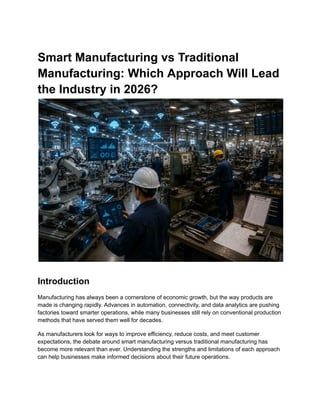
Advanced manufacturing encompasses the digital, automated, and data-driven systems reshaping modern production. It represents a convergence of computing power, connectivity, and intelligent machinery working in concert.
Core Characteristics
- Automation and robotics — from collaborative robots to fully automated cells
- IoT-enabled machinery — real-time monitoring and predictive maintenance
- Additive manufacturing — 3D printing for rapid prototyping and complex geometries
- AI and machine learning — quality inspection, demand forecasting, process optimization
- Digital twins — virtual replicas for simulation and testing
- Smart factory integration — interconnected systems sharing data across the value chain
Advantages of Advanced Manufacturing
Advanced technologies deliver unmatched precision, scalability, and adaptability. Automated systems maintain consistent quality at high throughput, while data analytics enable proactive decision-making. Predictive maintenance reduces unplanned downtime, and flexible systems allow manufacturers to pivot production quickly in response to demand shifts. Energy efficiency and waste reduction also improve substantially.
Limitations
Adoption requires significant upfront investment in equipment, software, and workforce training. Integration complexity can be daunting, and cybersecurity becomes a critical operational concern. For low-volume or highly specialized production, the return on investment may not justify the cost.
Side-by-Side Comparison
| Initial Investment | Lower | Higher |
| Flexibility | Limited | High |
| Quality Consistency | Operator-dependent | Highly consistent |
| Scalability | Linear with labor | Efficient at scale |
| Data Utilization | Minimal | Comprehensive |
| Workforce Requirements | Manual skill emphasis | Technical and digital skills |
| Adaptability to Change | Slow | Rapid |
How to Choose the Right Approach
The decision is rarely binary. Most successful manufacturers adopt a hybrid strategy, blending traditional reliability with advanced capability where it delivers the greatest value. Consider the following questions:
The Bottom Line
Traditional manufacturing remains a legitimate and often optimal choice—but it is increasingly a stepping stone rather than a destination. Advanced technologies are becoming more accessible, more affordable, and more essential to competing in a market defined by speed, customization, and data. The manufacturers who thrive will be those who assess their operations honestly, invest deliberately, and integrate new capabilities without discarding what already works.
The question is not whether to adopt advanced manufacturing, but where, when, and how fast.