

Industrial equipment is the backbone of modern manufacturing, energy production, and logistics. When critical assets fail unexpectedly, the consequences ripple far beyond the maintenance department: production halts, delivery commitments slip, safety risks increase, and repair costs climb. For technology and operations leaders, equipment maintenance is no longer a reactive cost center but a strategic discipline that directly influences uptime, product quality, and profitability.
This article outlines the best practices that high-performing industrial organizations adopt to keep their equipment reliable, safe, and productive across its entire lifecycle.
1. Shift from Reactive to Predictive Maintenance
The most consequential decision in any maintenance strategy is when to act. Traditional reactive maintenance—repairing equipment only after it breaks—is expensive and disruptive. Preventive maintenance, based on fixed schedules, improves on this but can still lead to unnecessary servicing or missed faults. Predictive maintenance, powered by condition monitoring and data analytics, represents the current gold standard.
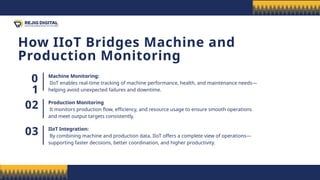
Predictive programs use sensors to track vibration, temperature, pressure, current draw, and lubricant condition in real time. Machine learning models then identify patterns that precede failure, allowing teams to intervene precisely when needed.
- Vibration analysis for rotating equipment such as motors, pumps, and compressors.
- Thermography for detecting electrical hotspots and mechanical friction.
- Oil analysis to monitor wear particles and lubricant degradation.
- Ultrasonic inspection for early detection of leaks and bearing faults.
Organizations that implement predictive maintenance typically report significant reductions in unplanned downtime and maintenance costs, while extending the useful life of critical assets.
2. Build a Robust Asset Registry and Maintenance Schedule
You cannot maintain what you have not documented. A comprehensive asset registry—capturing equipment specifications, serial numbers, maintenance history, warranty terms, and spare parts requirements—is the foundation of every effective maintenance program.
Once assets are cataloged, establish a maintenance schedule that combines manufacturer recommendations with operational data. Criticality analysis helps prioritize: not every asset warrants the same attention, and resources should flow toward equipment whose failure would cause the greatest operational, financial, or safety impact.
Key elements of a strong maintenance schedule
3. Invest in a Computerized Maintenance Management System (CMMS)
Spreadsheets and paper logs cannot keep pace with modern industrial operations. A CMMS centralizes work orders, asset histories, inventory, and scheduling into a single source of truth. It enables technicians to log findings in the field, managers to track key performance indicators, and planners to forecast resource needs.
When integrated with enterprise resource planning (ERP) and IoT platforms, a CMMS becomes a powerful decision-support tool. Maintenance data feeds directly into procurement, production planning, and capital expenditure conversations—elevating maintenance from a tactical function to a strategic one.
4. Prioritize Training and Workforce Development
Technology is only as effective as the people operating it. Skilled technicians who understand both the mechanical systems and the digital tools that monitor them are essential. As predictive maintenance and automation expand, the demand for hybrid skills—mechanical aptitude combined with data literacy—continues to grow.
Best-in-class organizations invest in structured onboarding, certification pathways, and cross-training programs. They also capture institutional knowledge through documented procedures and digital work instructions, reducing dependence on any single individual and safeguarding continuity as experienced staff retire.
5. Manage Spare Parts and Inventory Strategically
Stockouts of critical components can extend a repair from hours to weeks. Conversely, overstocking ties up capital and consumes valuable floor space. Effective spare parts management balances these risks through data-driven inventory policies.
| Critical, long lead-time | Maintain on-site stock | Prevents extended downtime from supply delays |
| High-usage consumables | Automated reorder points | Ensures availability without manual intervention |
| Low-risk, short lead-time | Vendor-managed or on-demand | Reduces carrying costs and obsolescence risk |
6. Foster a Culture of Safety and Continuous Improvement
Maintenance work carries inherent hazards—lockout/tagout procedures, confined spaces, electrical systems, and heavy machinery. A culture that prioritizes safety is non-negotiable. Standardized procedures, regular safety audits, and near-miss reporting should be embedded in daily operations, not treated as administrative overhead.
Equally important is a mindset of continuous improvement. Leading organizations review maintenance metrics—mean time between failures (MTBF), mean time to repair (MTTR), overall equipment effectiveness (OEE), and planned versus unplanned work ratios—and use them to refine processes. Root cause analysis after significant failures should be routine, with findings translated into updated procedures and design improvements.
Metrics worth tracking
- MTBF — reliability indicator for critical assets.
- MTTR — responsiveness and efficiency of repair efforts.
- OEE — overall equipment effectiveness across availability, performance, and quality.
- PM compliance — percentage of scheduled maintenance completed on time.
Conclusion
Industrial equipment maintenance has evolved into a data-driven, technology-enabled discipline. The organizations that excel combine predictive technologies, disciplined asset management, skilled people, and a culture of safety and improvement. The result is more than reduced downtime—it is a measurable competitive advantage built on reliability, efficiency, and operational excellence.
For technology leaders, the mandate is clear: treat maintenance as an investment in asset performance, not a cost to be minimized. The tools and practices are available today. The organizations that adopt them will define the standard for industrial reliability in the years ahead.