
Programmable Logic Controllers (PLCs) are the backbone of modern industrial automation. From assembly lines and packaging plants to water treatment facilities and power grids, these ruggedized industrial computers execute the control logic that keeps production running safely, reliably, and efficiently. This article explains what PLC systems are, how they work, and where they deliver the most value in industrial automation.
What Is a PLC?
A Programmable Logic Controller is an industrial digital computer that has been hardened for harsh environments and designed to execute deterministic control programs in real time. Unlike general-purpose computers, a PLC is engineered for continuous operation, immunity to electrical noise, vibration resistance, and predictable scan-cycle performance.
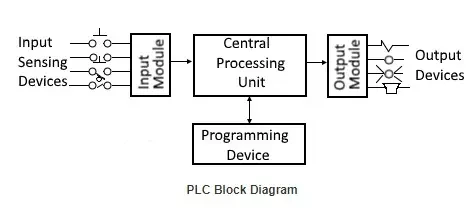
At its core, a PLC reads inputs from sensors and field devices, executes a user-defined control program, and writes outputs to actuators, drives, and indicators. This read-execute-write loop, known as the scan cycle, repeats continuously—typically in milliseconds—ensuring responsive and repeatable control.
Core Components of a PLC System
- Processor (CPU): Executes the control program and manages communication between modules.
- Power Supply: Converts incoming AC or DC power to the voltages required by the controller and I/O modules.
- Input/Output (I/O) Modules: Interface with sensors, switches, relays, drives, and other field devices.
- Communication Interfaces: Enable connectivity over Ethernet/IP, Modbus, PROFINET, and other industrial protocols.
- Programming Terminal: Engineering software used to develop, download, and monitor control logic.
How PLCs Differ from Other Control Technologies
PLCs occupy a distinct position among industrial control solutions. Compared with hardwired relay logic, they offer far greater flexibility, easier troubleshooting, and simplified modification. Compared with distributed control systems (DCS), PLCs are generally more cost-effective for discrete and hybrid applications. And compared with PC-based control, PLCs provide superior determinism and environmental robustness.
| Relay Logic | Simple, fixed control tasks | Low initial cost |
| PLC | Discrete, batch, and hybrid automation | Reliability and flexibility |
| DCS | Large continuous process plants | Integrated process control |
| PC-Based Control | Data-intensive and vision applications | High computing power |
Key Applications in Industrial Automation
1. Manufacturing and Assembly Lines
PLCs coordinate conveyors, robotic cells, pick-and-place stations, and tooling sequences with precise timing. They interlock safety circuits, manage part tracking, and synchronize equipment so that high-throughput production lines operate without bottlenecks or hazardous conditions.
2. Process Control
In chemical, food and beverage, and pharmaceutical environments, PLCs regulate temperature, pressure, flow, and level through PID control loops. Modern controllers handle recipe management, batch sequencing, and regulatory compliance logging—capabilities once reserved for larger control systems.
3. Material Handling and Logistics
Warehouse automation depends on PLCs to control sortation systems, automated storage and retrieval systems (AS/RS), and conveyor networks. Integration with barcode scanners and warehouse management software enables real-time routing and inventory accuracy.
4. Water and Wastewater Treatment
Municipal and industrial treatment facilities use PLCs to monitor pumps, valves, chemical dosing, and filtration stages. Remote I/O and telemetry capabilities allow operators to supervise distributed sites from a central control room.
5. Energy and Utilities
PLCs support turbine control, substation automation, and renewable energy assets such as solar trackers and wind turbine subsystems. Their deterministic behavior and wide temperature ratings make them well suited to remote and outdoor installations.
6. Packaging and Palletizing
High-speed packaging machinery relies on PLCs for motion coordination, registration control, and changeover management. When paired with servo systems, PLCs deliver the precision required for labeling, filling, and case packing.
Advantages of PLC-Based Automation
- Reliability: Designed for 24/7 operation in demanding environments.
- Scalability: Modular I/O and networking support system growth without redesign.
- Diagnostics: Built-in fault detection and remote monitoring reduce downtime.
- Safety Integration: Safety-rated controllers and I/O support compliant machine safety architectures.
- Interoperability: Support for open industrial protocols simplifies integration with SCADA, MES, and IIoT platforms.
Implementation Best Practices
Conclusion
PLC systems remain the workhorse of industrial automation because they combine deterministic performance, rugged reliability, and architectural flexibility. Whether the application is a discrete assembly line, a continuous process plant, or a distributed utility network, a well-designed PLC architecture provides the foundation for safe, efficient, and future-ready operations. As industrial operations converge with IT and IIoT technologies, the PLC will continue to evolve—but its role as the trusted control layer of the plant floor is secure.