

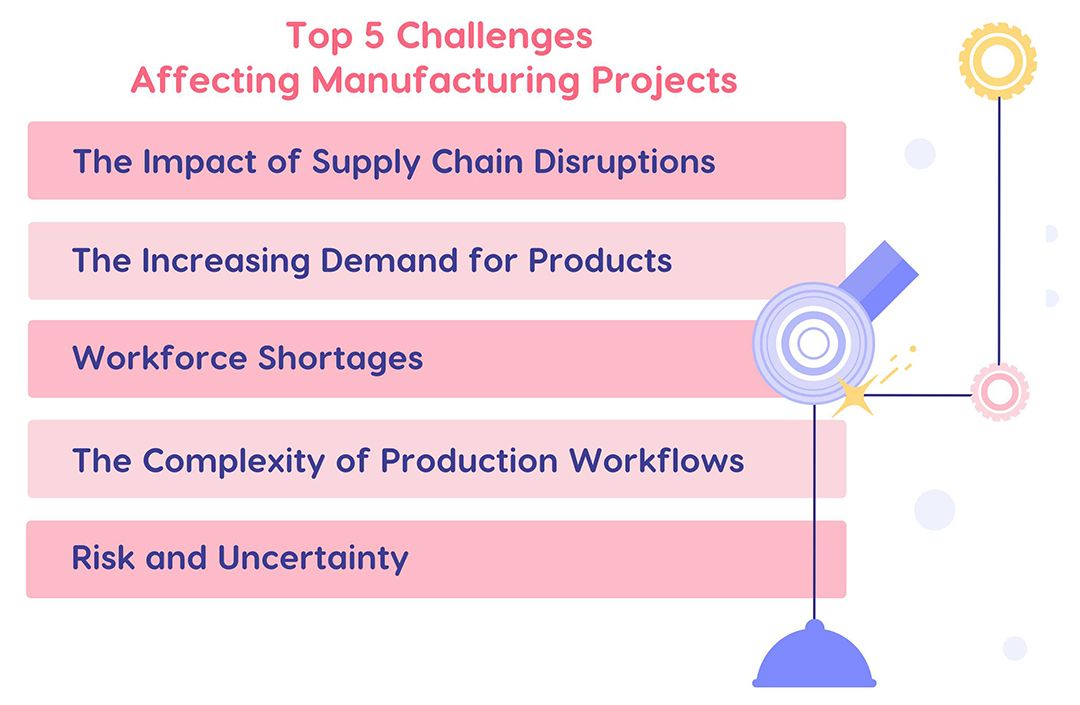
Manufacturing is the backbone of the global economy, yet it remains one of the most demanding industries to operate in. From supply chain volatility to the persistent skills gap, manufacturers face a complex web of challenges that can erode margins, delay production, and jeopardize customer relationships. The good news is that these challenges are well understood—and, with the right strategies and technologies, largely addressable. This article examines the most common manufacturing challenges and outlines practical approaches to overcoming them.
1. Supply Chain Disruptions and Volatility
Few challenges have tested manufacturers as thoroughly as supply chain instability. Geopolitical tensions, natural disasters, transportation bottlenecks, and fluctuating demand have exposed the fragility of lean, single-source supply networks. When a critical component fails to arrive, entire production lines can grind to a halt.
How to Address It
- Diversify suppliers: Qualify secondary and regional suppliers for critical components to reduce dependence on any single source.
- Increase supply chain visibility: Deploy real-time tracking and supplier collaboration platforms so disruptions are detected early.
- Adopt strategic inventory buffers: Rebalance just-in-time practices with targeted safety stock for high-risk materials.
- Scenario planning: Model potential disruptions and predefine contingency playbooks.
2. The Skilled Labor Shortage
An aging workforce, declining interest in technical trades, and rapid technological change have created a persistent skills gap. Manufacturers increasingly struggle to fill roles in machining, maintenance, quality assurance, and automation engineering—and the cost of unfilled positions is measured in lost output and overtime expenses.
How to Address It
- Invest in workforce development: Partner with vocational schools and universities to build talent pipelines.
- Create internal training academies: Upskilling existing employees is often faster and cheaper than external hiring.
- Leverage automation strategically: Deploy robotics and cobots to handle repetitive tasks, freeing skilled workers for higher-value activities.
- Document tribal knowledge: Capture institutional expertise in digital work instructions before experienced workers retire.
3. Equipment Downtime and Maintenance Costs
Unplanned downtime is one of the most expensive problems in manufacturing, costing operations significant revenue per hour depending on the industry. Reactive maintenance cultures leave equipment vulnerable to sudden failures, while over-maintenance wastes resources.
How to Address It
- Implement predictive maintenance: Use IoT sensors and machine learning to monitor equipment health and schedule maintenance before failures occur.
- Adopt a CMMS: A computerized maintenance management system centralizes work orders, spare parts, and asset histories.
- Track OEE: Overall Equipment Effectiveness metrics reveal where availability, performance, and quality losses occur.
- Build spares strategy: Maintain critical spare parts based on failure probability and lead times.
4. Quality Control and Consistency
Defects and variability damage brand reputation, trigger recalls, and generate rework costs. As production speeds increase and product complexity grows, maintaining consistent quality becomes harder—especially across multiple shifts and facilities.
How to Address It
- Embrace statistical process control: Monitor key parameters in real time to catch drift before defects occur.
- Deploy automated inspection: Machine vision systems detect defects faster and more consistently than manual inspection.
- Standardize work: Clear, digitized work instructions reduce variation across shifts and sites.
- Close the feedback loop: Feed quality data back into design and process engineering for continuous improvement.
5. Rising Operational Costs and Margin Pressure
Energy prices, raw material inflation, and wage growth continue to compress margins. Manufacturers must find efficiency gains without compromising quality or delivery performance—a delicate balancing act.
How to Address It
- Conduct energy audits: Identify high-consumption equipment and implement efficiency retrofits.
- Reduce waste: Apply lean methodologies to eliminate scrap, overproduction, and unnecessary motion.
- Optimize scheduling: Advanced planning systems reduce changeover time and improve throughput.
- Renegotiate strategically: Use data on consumption patterns to negotiate better terms with suppliers.
6. Legacy Systems and Digital Transformation
Many manufacturers operate with a patchwork of disconnected systems—spreadsheets, legacy ERPs, and standalone machine controllers. This fragmentation limits visibility and makes data-driven decision-making difficult.
How to Address It
- Start with a roadmap: Define a phased digital transformation strategy aligned with business goals rather than chasing technology for its own sake.
- Prioritize interoperability: Choose platforms with open APIs and industry standards such as OPC UA.
- Pilot before scaling: Validate initiatives on a single line or facility before enterprise-wide rollout.
- Invest in cybersecurity: Connect OT and IT environments with robust security controls to protect production systems.
7. Sustainability and Regulatory Compliance
Environmental regulations, customer expectations, and investor pressure are pushing manufacturers toward sustainable operations. At the same time, compliance requirements around emissions, waste, and product stewardship continue to expand.
How to Address It
- Measure your footprint: Establish baseline data on energy, water, and emissions across operations.
- Set science-based targets: Commit to measurable reductions and track progress transparently.
- Design for circularity: Incorporate recyclability and material efficiency into product design.
- Digitize compliance: Use software to track regulatory obligations and automate reporting.
Summary of Challenges and Solutions
| Supply chain volatility | Production stoppages | Supplier diversification and visibility |
| Skills shortage | Lost output, overtime costs | Training academies and automation |
| Equipment downtime | Revenue loss per hour | Predictive maintenance and OEE tracking |
| Quality inconsistency | Recalls and rework | SPC and automated inspection |
| Cost pressure | Margin erosion | Lean waste reduction and energy audits |
| Legacy systems | Limited visibility | Phased digital transformation |
| Regulatory pressure | Compliance risk | Baseline measurement and digitized reporting |
Conclusion
Manufacturing challenges are neither new nor insurmountable. The organizations that thrive are those that treat these obstacles as engineering problems: define them precisely, measure them rigorously, and attack them systematically. By combining workforce investment, predictive technologies, supply chain resilience, and a disciplined approach to continuous improvement, manufacturers can convert today’s pressures into durable competitive advantage.
The most successful manufacturers are not those without problems—they are those with the fastest, most disciplined problem-solving systems.