
In the modern industrial landscape, unplanned downtime is more than an inconvenience—it is a direct threat to profitability, safety, and competitive standing. Equipment failures can halt production lines, compromise worker safety, and erode customer trust. The antidote to this operational fragility is a robust, well-executed industrial maintenance plan. Yet many organizations still operate in a reactive mode, addressing failures only after they occur. Developing an effective maintenance plan requires a strategic shift from firefighting to foresight, supported by data, disciplined processes, and a culture of continuous improvement.
This article outlines a practical, step-by-step approach to building an industrial maintenance plan that reduces downtime, extends asset life, and aligns maintenance activities with broader business objectives.
Why a Formal Maintenance Plan Matters
A maintenance plan is not merely a schedule of repairs; it is a comprehensive framework that governs how assets are monitored, serviced, and replaced. Organizations with mature maintenance programs consistently report measurable gains: reduced unplanned downtime, lower spare-parts costs, improved energy efficiency, and extended equipment lifespans.
The financial case is compelling. Reactive maintenance, often called “run-to-failure,” typically costs several times more than planned maintenance over an asset’s lifecycle. When a critical pump or motor fails unexpectedly, organizations absorb overtime labor, expedited shipping, lost production, and potential safety incidents. A structured plan converts these unpredictable costs into controlled, budgetable expenses.
Step 1: Conduct a Comprehensive Asset Inventory
You cannot maintain what you have not documented. The foundation of any effective plan is a complete, accurate asset register. Begin by cataloging every piece of equipment, from production machinery and HVAC systems to conveyors and compressors.
For each asset, capture the following details:
- Identification: Asset ID, manufacturer, model number, and serial number
- Specifications: Capacity, power requirements, and operating parameters
- Criticality: Impact on production, safety, and regulatory compliance if the asset fails
- Location: Physical placement within the facility
- History: Installation date, past failures, and service records
Modern computerized maintenance management systems (CMMS) streamline this process, creating a searchable, centralized repository of asset data. Accurate documentation at this stage pays dividends throughout the life of the plan.
Step 2: Prioritize Assets by Criticality
Not all equipment deserves equal attention. A criticality analysis helps allocate resources where they matter most. Rank assets based on the consequences of failure, considering factors such as production impact, safety risk, environmental exposure, and repair cost.
A common approach is to classify assets into tiers:
| Tier 1 (Critical) | Failure halts production or poses serious safety risk | Predictive and preventive maintenance with continuous monitoring |
| Tier 2 (Important) | Failure causes partial disruption or moderate cost | Scheduled preventive maintenance |
| Tier 3 (Standard) | Failure has limited operational impact | Run-to-failure or periodic inspection |
This tiered structure ensures that high-value, high-risk equipment receives the attention and investment it warrants, while lower-priority assets are managed cost-effectively.
Step 3: Select the Right Maintenance Strategies
Effective plans blend multiple maintenance approaches rather than relying on a single methodology. The principal strategies include:
Predictive maintenance has gained significant traction with the advent of Industrial Internet of Things (IIoT) technology. Connected sensors transmit real-time data to analytics platforms, enabling maintenance teams to intervene precisely when needed—neither too early nor too late. This condition-based approach reduces unnecessary servicing while preventing catastrophic failures.
Step 4: Build a Detailed Maintenance Schedule
With strategies selected, translate them into an actionable schedule. For each asset, define the specific tasks, required resources, and frequency of execution. A well-constructed schedule answers the questions: What needs to be done, by whom, when, and with what tools or parts?
Consider these best practices when building the schedule:
- Align with production calendars: Schedule intrusive maintenance during planned shutdowns or low-demand periods.
- Balance workload: Distribute tasks to prevent technician overload during peak periods.
- Account for lead times: Order long-lead spare parts well in advance of scheduled work.
- Document procedures: Provide standardized work instructions to ensure consistency and safety.
Step 5: Implement a CMMS and Leverage Data
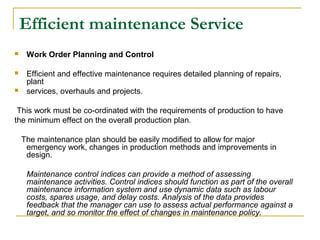
A CMMS is the operational backbone of a modern maintenance plan. It manages work orders, tracks asset histories, schedules PM tasks, monitors inventory, and generates performance reports. Beyond administration, the system’s data supports evidence-based decision-making.
Key performance indicators (KPIs) to monitor include:
- Mean Time Between Failures (MTBF): Reliability indicator for repairable assets
- Mean Time to Repair (MTTR): Efficiency of maintenance response
- Overall Equipment Effectiveness (OEE): Combined measure of availability, performance, and quality
- Planned Maintenance Compliance: Percentage of scheduled tasks completed on time
- Maintenance Cost per Unit Produced: Financial efficiency of the program
Regular review of these metrics reveals trends, highlights problem assets, and informs continuous refinement of the plan.
Step 6: Train, Engage, and Standardize
Even the most sophisticated plan fails without capable people to execute it. Invest in technician training covering equipment-specific procedures, safety protocols, and digital tools. Cross-training builds resilience, ensuring coverage during absences.
Standardization reinforces consistency. Develop written procedures for routine tasks, adopt lockout/tagout protocols, and maintain a structured spare-parts inventory. Encourage frontline technicians to report observations and suggest improvements—their hands-on knowledge is invaluable for identifying emerging issues and refining schedules.
Step 7: Review, Measure, and Improve Continuously
An effective maintenance plan is a living document. Conduct quarterly reviews of performance data, reassess asset criticality as operations evolve, and adjust strategies based on findings. Apply root cause analysis to significant failures to prevent recurrence.
Continuous improvement methodologies such as Plan-Do-Check-Act (PDCA) provide a structured framework for iteration. Over time, small refinements compound into substantial gains in reliability and cost efficiency.
Conclusion
Developing an effective industrial maintenance plan is a disciplined, multi-phase endeavor: inventory your assets, prioritize by criticality, select appropriate strategies, schedule meticulously, deploy enabling technology, empower your workforce, and commit to continuous improvement. Organizations that treat maintenance as a strategic function rather than a cost center will find that a well-executed plan delivers not only fewer breakdowns, but also greater productivity, safer operations, and a stronger bottom line. The technology and expertise required are available today—the differentiator is the commitment to build and sustain the program.