

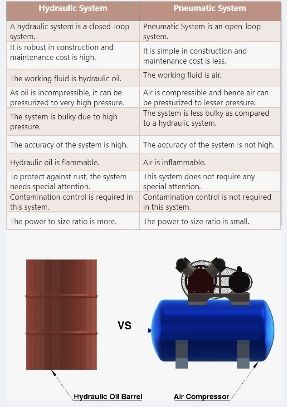
In industrial automation and heavy machinery, fluid power drives the world. Hydraulic and pneumatic systems are the two dominant technologies for transmitting force and motion, and while they share a common principle—harnessing a pressurized fluid to do work—they behave very differently in practice. Choosing the wrong one can mean the difference between precision and power loss, or between efficiency and costly downtime. This article breaks down the key differences between hydraulic and pneumatic systems so engineers and decision-makers can specify with confidence.
The Fundamentals: How Each System Works
Hydraulic systems use an incompressible liquid—typically mineral oil or a synthetic fluid—to transmit force. Because the fluid cannot be compressed, hydraulic systems deliver immediate, rigid response and can generate enormous force from a relatively small actuator. They are the backbone of excavators, presses, and heavy lifting equipment.
Pneumatic systems use compressed air as the working medium. Air is compressible, which introduces a degree of cushioning and elasticity into the system. Pneumatics excel in fast, repetitive, low-to-medium force applications such as packaging lines, pick-and-place robots, and clamping mechanisms.
Head-to-Head Comparison
The table below summarizes the most important distinctions across performance, cost, and operating characteristics.
| Power density | Very high; ideal for heavy loads | Moderate; suited to lighter loads |
| Force capability | Extremely high force from compact actuators | Limited by compressor pressure and cylinder size |
| Precision & control | Excellent; smooth, accurate positioning | Less precise due to air compressibility |
| Speed | Moderate; fast but limited by fluid flow | Very fast, high cycle rates |
| Operating pressure | Typically 1,000–5,000 psi | Typically 80–120 psi |
| Cleanliness | Risk of leaks; fluid disposal required | Clean; exhaust is simply air |
| Maintenance | Higher; fluid filtration and leak management | Lower; simple components, fewer fluids |
| Initial cost | Higher; pumps, reservoirs, filtration | Lower; compressors and simple valving |
| Energy efficiency | Efficient for high-force, continuous duty | Less efficient; compression generates heat |
| Best environment | Heavy industry, mobile machinery, presses | Clean rooms, food handling, assembly lines |
Power Density and Force Output
The single most decisive difference is power density. Hydraulic fluid is incompressible, so a hydraulic cylinder can produce thousands of pounds of force from a compact footprint. A pneumatic cylinder of comparable size cannot approach that output because air compresses under load—energy is absorbed rather than transmitted directly. When your application demands lifting, crushing, or pressing, hydraulics is almost always the answer. When it demands speed and repetition at modest force, pneumatics wins on simplicity.
Precision, Control, and Responsiveness
Hydraulics offers superior control characteristics. Proportional and servo valves allow fine modulation of flow and pressure, enabling smooth acceleration, deceleration, and accurate position holding. Pneumatic systems, by contrast, are inherently springy; achieving precise mid-stroke positioning requires additional sensors and closed-loop control, which erodes the cost advantage. For applications where exact movement matters—think CNC press brakes or flight simulators—hydraulics remains the standard.
Cost, Maintenance, and Energy Considerations
Pneumatics typically requires a lower upfront investment: components are simpler, and the working fluid is free and abundant. However, compressed air is an expensive form of energy—compression losses and leaks can waste a significant portion of the input power. Hydraulic systems cost more to build and maintain, requiring filtration, fluid monitoring, and leak prevention, but they deliver better efficiency in high-force, continuous-duty applications.
- Hydraulics: higher capital cost, higher maintenance burden, superior efficiency under heavy loads.
- Pneumatics: lower capital cost, simpler upkeep, but higher energy cost per unit of work delivered.
Safety and Environmental Factors
Both technologies carry distinct safety profiles. Hydraulic systems operate at extreme pressures; a pinhole leak can inject fluid into skin, and hose failure poses serious hazards. Fluid leaks also create slip risks and environmental concerns, particularly in food processing or marine environments. Pneumatic systems are generally safer to handle, but compressed air carries its own risks—stored energy, noise, and the potential for sudden actuator movement when pressure is released.
Conclusion
Neither technology is universally superior; the correct choice depends on the physics of the application. Hydraulics dominates where force density, precision, and heavy-duty reliability are non-negotiable. Pneumatics excels where speed, cleanliness, simplicity, and low initial cost matter most. The most effective engineering teams treat the two as complementary tools—sometimes combining them in hybrid systems—and select based on a disciplined analysis of load, speed, precision, and total cost of ownership.