
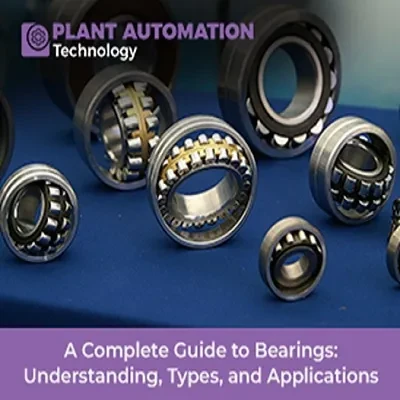
Bearings are among the most underappreciated components in modern engineering. Hidden inside motors, conveyors, turbines, and robotic joints, these precision elements perform one essential function: they allow parts to move relative to one another while carrying loads and minimizing friction. When a bearing performs as designed, no one notices. When it fails, entire production lines can grind to a halt. For engineers, procurement specialists, and maintenance teams, a solid understanding of bearing types and their industrial applications is not optional—it is a competitive advantage.
What Is a Bearing?
A bearing is a mechanical component that constrains relative motion to only the desired motion while reducing friction between moving parts. Bearings support radial loads (perpendicular to the shaft), axial loads (parallel to the shaft), or a combination of both. The core principle is simple: by introducing rolling elements or a fluid film between surfaces, a bearing converts sliding friction into rolling friction or fluid friction, dramatically reducing energy loss and wear.
Bearing selection hinges on several factors: load magnitude and direction, operating speed, temperature, environmental conditions, required precision, and maintenance access. Getting these parameters right determines whether a machine runs reliably for decades or fails within months.
The Main Bearing Categories
Rolling-Element Bearings
Rolling-element bearings use spheres, cylinders, or tapered rollers to separate moving surfaces. They are the workhorses of industry, prized for low friction, high load capacity, and interchangeability.
- Ball bearings: Use spherical rolling elements. Ideal for high-speed, moderate-load applications such as electric motors, fans, and pumps.
- Cylindrical roller bearings: Support heavy radial loads and are common in gearboxes and rolling mills.
- Tapered roller bearings: Handle combined radial and axial loads, making them standard in wheel hubs and heavy machinery.
- Spherical roller bearings: Self-aligning and tolerant of misalignment, suited to mining and paper-processing equipment.
- Needle roller bearings: Compact and space-efficient, used in transmissions and small motors.
Plain Bearings
Plain bearings, also called sleeve or bushings, rely on a sliding contact surface rather than rolling elements. They are simple, quiet, and cost-effective, excelling in high-load, low-speed, or contaminated environments where rolling elements would fail prematurely. Common materials include bronze, babbitt, and polymer composites.
Specialized Bearings
- Thrust bearings: Designed specifically for axial loads, found in turbines and propeller shafts.
- Magnetic bearings: Levitate the shaft using magnetic fields, enabling near-zero friction and oil-free operation in high-speed turbomachinery.
- Fluid and air bearings: Use a pressurized film of fluid or gas to support the load, delivering exceptional precision for machine tools and metrology equipment.
Key Industrial Applications
Bearings appear in virtually every sector of manufacturing and energy production. The table below summarizes common bearing types and the industries that depend on them most.
| Deep groove ball bearing | Radial and light axial | Electric motors, HVAC fans, household appliances |
| Tapered roller bearing | Combined radial and axial | Automotive hubs, gearboxes, construction equipment |
| Spherical roller bearing | Heavy radial with misalignment | Mining crushers, paper mills, conveyors |
| Cylindrical roller bearing | Heavy radial | Rolling mills, industrial gearboxes, turbines |
| Plain sleeve bearing | Radial (high load, low speed) | Marine propeller shafts, pumps, crushers |
| Thrust bearing | Axial | Steam turbines, vertical pumps, cranes |
| Magnetic bearing | Radial and axial (contactless) | High-speed compressors, vacuum pumps, flywheels |
Power Generation and Energy
Wind turbines rely on large spherical and tapered roller bearings in their main shafts, gearboxes, and blade pitch systems. Steam and gas turbines use precision thrust and journal bearings to handle immense axial forces at high speeds. In hydroelectric plants, plain bearings support the enormous weight of turbine shafts with remarkable reliability.
Manufacturing and Automation
From CNC machine spindles to robotic arms, bearings dictate precision and repeatability. Linear bearings guide tool slides, ball screws convert rotary motion into precise linear movement, and miniature ball bearings keep high-speed spindles running true. In automated assembly lines, sealed bearings protect against dust and coolant ingress, extending service intervals.
Heavy Industry and Mining
Crushers, conveyors, and grinding mills operate under brutal conditions: shock loads, abrasive dust, and extreme temperatures. Spherical roller bearings and rugged plain bearings are the standard choice here, often paired with advanced sealing and lubrication systems.
Automotive and Transportation
Wheel hubs, transmissions, alternators, and turbochargers all depend on bearings selected for specific load and speed profiles. Tapered roller bearings dominate wheel applications, while needle bearings keep gearboxes compact.
Selection, Lubrication, and Maintenance
Choosing the right bearing is only half the battle. Correct installation, lubrication, and monitoring determine service life. Consider the following best practices:
Conclusion
Bearings are small components with an outsized impact on industrial performance. Understanding the distinctions between ball, roller, plain, and specialized bearings—and matching each type to its ideal application—enables engineers to design more efficient machines, reduce downtime, and control lifecycle costs. As industry moves toward higher speeds, greater precision, and smarter maintenance, bearing technology will continue to evolve, but the fundamentals covered here remain the foundation of sound mechanical design.