
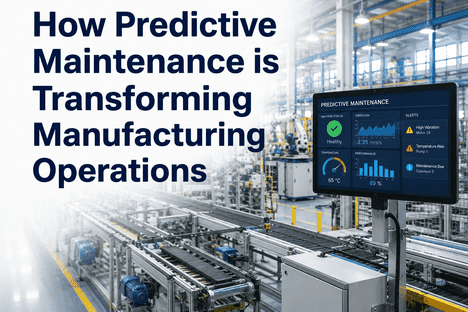
In an era where unplanned downtime can cost industrial operations millions of dollars per year, maintenance strategy has evolved from a reactive necessity into a strategic advantage. Predictive maintenance (PdM) sits at the forefront of this transformation, leveraging data, analytics, and connected technologies to anticipate equipment failures before they occur. The result is not merely fewer breakdowns but a measurable, compounding improvement in operational efficiency across the entire enterprise.
This article examines how predictive maintenance works, why it outperforms traditional approaches, and how organizations can quantify its impact on efficiency.
From Reactive to Predictive: A Necessary Evolution
Maintenance strategies have traditionally fallen into two categories. Reactive maintenance waits for equipment to fail and then repairs it—simple, but enormously expensive in lost production, safety risk, and secondary damage. Preventive (time-based) maintenance replaces or services components on a fixed schedule, which reduces some failures but often replaces healthy parts and still misses random faults altogether.
Predictive maintenance takes a fundamentally different approach. By continuously monitoring equipment condition through sensors, operational data, and advanced analytics, PdM identifies the earliest indicators of degradation—vibration anomalies, thermal drift, lubrication breakdown, current signature changes—and schedules intervention precisely when it is needed. The shift moves maintenance from a calendar-driven cost center to a condition-driven efficiency driver.
Core Mechanisms Behind Predictive Maintenance
Predictive maintenance is built on a technology stack that converts raw machine data into actionable decisions. Key components include:
- Condition monitoring sensors that capture vibration, temperature, pressure, acoustics, and electrical signals in real time.
- Industrial IoT connectivity that streams data from assets on the plant floor to centralized platforms.
- Machine learning models trained to recognize patterns that precede failure, distinguishing normal operating variance from genuine degradation.
- Digital twins that simulate asset behavior and enable scenario testing without disrupting production.
- Computerized maintenance management systems (CMMS) that automatically generate work orders when thresholds are breached.
Together, these elements create a closed loop: sense, analyze, predict, and act. Each cycle refines the model, improving accuracy over time.
How Predictive Maintenance Drives Operational Efficiency
1. Reducing Unplanned Downtime
Unplanned downtime is the single largest efficiency drain in most industrial environments. PdM converts unexpected failures into planned, scheduled interventions. Maintenance can be performed during planned shutdowns, shift changes, or low-demand periods, eliminating the production losses associated with emergency repairs. Studies across manufacturing, energy, and transportation consistently show double-digit reductions in unplanned downtime following PdM deployment.
2. Extending Asset Lifespan
By catching degradation early, PdM prevents small faults from escalating into catastrophic damage. A bearing showing early wear can be replaced in hours rather than allowing it to seize and destroy an entire drivetrain. This proactive intervention extends the service life of critical assets, defers capital expenditure, and improves return on asset investment.
3. Optimizing Maintenance Labor and Resources
Time-based maintenance consumes significant labor on unnecessary servicing. PdM directs technicians to the assets that actually need attention, when they need it. This reduces overtime, frees skilled staff for higher-value work, and tightens spare parts inventory management by aligning procurement with predicted demand rather than arbitrary schedules.
4. Improving Energy and Process Performance
Degrading equipment often operates inefficiently long before it fails—motors draw excess current, compressors lose efficiency, and heat exchangers foul. PdM detects these performance drifts and triggers corrective action, reducing energy consumption and improving overall process yield. Efficiency gains therefore accrue continuously, not only at the point of failure.
5. Enhancing Safety and Compliance
Failures in high-risk environments can have severe safety and regulatory consequences. Predictive maintenance reduces the likelihood of catastrophic failures, supports audit-ready documentation of asset condition, and aligns maintenance activities with regulatory and safety management requirements.
Quantifying the Efficiency Impact
Executives evaluating PdM investments should frame benefits in measurable operational terms. The table below summarizes typical efficiency outcomes reported across industrial deployments.
| Unplanned downtime | Reduction of 30–50% | Early fault detection and planned intervention |
| Maintenance cost | Reduction of 10–40% | Fewer unnecessary services and emergency repairs |
| Asset lifespan | Extension of 20–40% | Prevention of secondary damage |
| Spare parts inventory | Reduction of 20–30% | Demand-driven procurement |
| Energy consumption | Reduction of 5–15% | Detection of performance degradation |
These figures are not theoretical. They reflect outcomes reported across manufacturing, utilities, mining, and logistics operations. The precise magnitude depends on asset criticality, data maturity, and organizational readiness.
Implementing Predictive Maintenance Successfully
Technology alone does not deliver efficiency gains. Successful PdM programs follow a disciplined sequence:
Organizations that treat predictive maintenance as an operational discipline—rather than a one-time technology purchase—capture the greatest efficiency gains and sustain them over time.
Conclusion
Predictive maintenance transforms maintenance from a cost of doing business into a lever for operational excellence. By converting unplanned failures into planned interventions, extending asset life, optimizing labor and inventory, and improving energy performance, PdM delivers efficiency improvements that compound across the enterprise. For organizations seeking to remain competitive in increasingly demanding industrial environments, predictive maintenance is no longer optional—it is the standard against which operational efficiency is measured.